
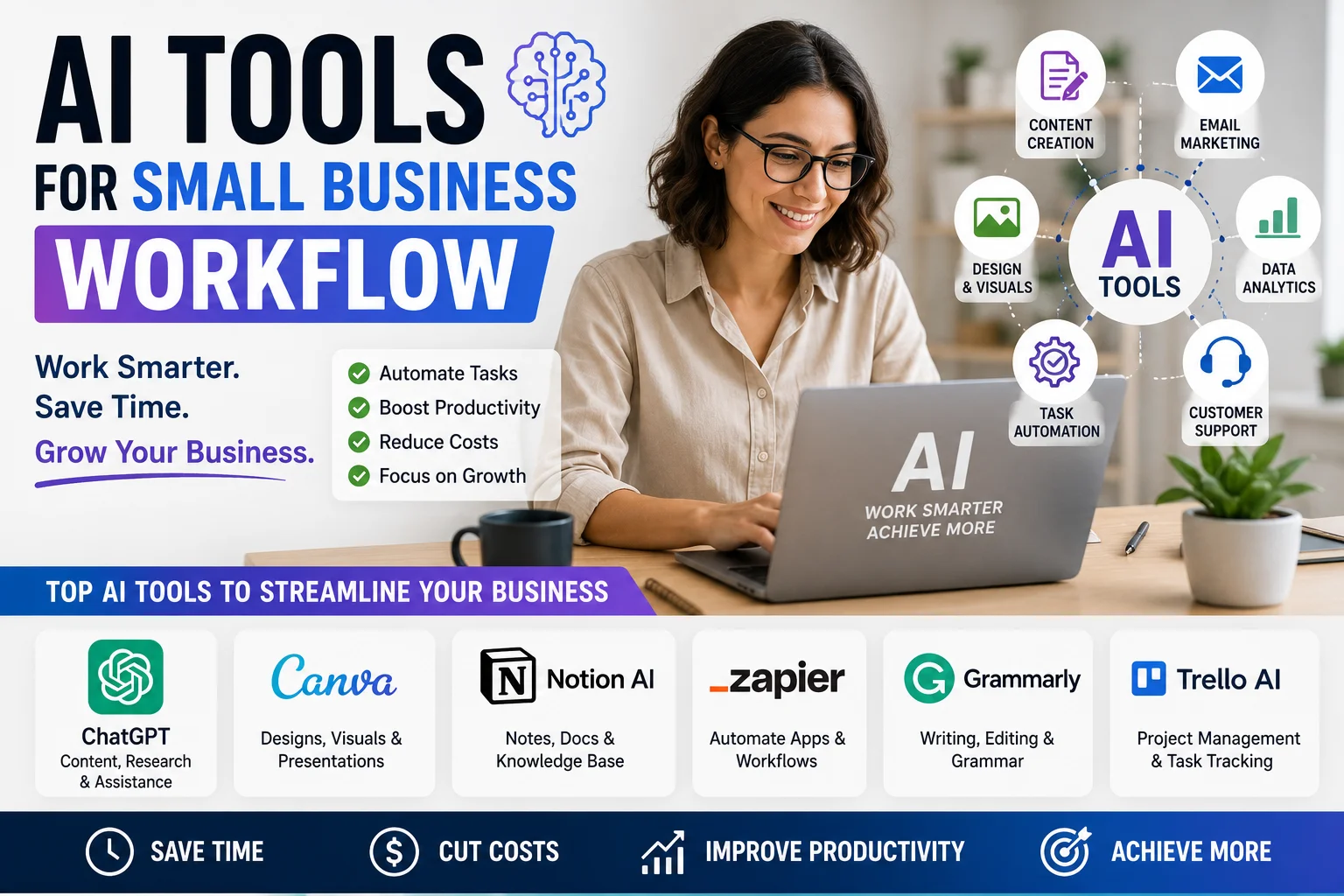
Small business owners drown in repetitive tasks every single day. Hours vanish on scheduling, invoicing, and answering emails while your revenue stalls and competitors pull ahead. The right AI tools for small business workflow eliminate that busywork instantly. This guide shows you exactly which platforms save time, cut costs, and free you to focus on real growth.
What Are AI Tools for Small Business Workflow?
AI tools for small business workflow are software platforms that use machine learning and natural language processing to handle repetitive daily operations. Think of them as digital employees that never sleep, never call in sick, and never make data entry errors.
These platforms connect to the apps you already use — your CRM, email inbox, accounting software, and project boards. They learn your patterns and start completing tasks on their own.
Common examples include chatbots that answer customer questions at 2 a.m., smart schedulers that book meetings without back-and-forth emails, and invoice processors that pull data from receipts automatically.
The goal is simple: remove friction from your operations so your team spends time on work that actually drives revenue.
Why Do Small Businesses Need AI Workflow Automation Now?
Running a small business with fewer than 20 employees means everyone wears multiple hats. Your marketing manager also handles customer support. Your bookkeeper also manages payroll. This stretched-thin reality creates bottlenecks that slow everything down.
AI tools for small business workflow automation fix this problem by taking over the tasks that eat up 30–40% of a typical workweek. According to research published by McKinsey & Company, generative AI can automate up to 60–70% of employee work activities across industries (McKinsey, 2023).
To get started, a big budget is not required. Many platforms offer free tiers or plans under $50 per month. The return shows up within the first two weeks as your team reclaims hours previously lost to manual processes.
Waiting to adopt these tools puts you behind competitors who already operate faster and leaner.
How Do AI Tools for Small Business Workflow Save Time?
Time savings come from three specific areas: task elimination, speed acceleration, and error reduction.
Task elimination means the software handles entire processes without human input. For example, an AI email assistant reads incoming messages, categorizes them by urgency, drafts replies, and queues them for your approval.
Speed acceleration happens when AI compresses multi-step processes into seconds. A task that once took your team 45 minutes — like generating a weekly sales report from three different spreadsheets — now completes in under 10 seconds.
Error reduction protects your time in a less obvious way. Every data entry mistake triggers a chain of corrections. AI eliminates those mistakes at the source, which means your team stops re-doing work they already finished.
When you combine all three, the average small business owner reclaims 10–15 hours per week. That is essentially two full workdays handed back to you.
Which AI Tools for Small Business Workflow Automation Work Best in 2025?
Choosing the right platform depends on your specific pain points. Below is a breakdown of the top-performing tools tested across real small business environments this year.
| Tool Name | Best For | Starting Price | Key AI Feature | Setup Time |
| Zapier + AI Actions | Connecting apps and automating multi-step tasks | Free (paid from $29/mo) | Natural language workflow builder | 15–30 minutes |
| HubSpot AI Assistant | CRM, email marketing, and sales pipelines | Free (paid from $20/mo) | AI-generated email sequences and lead scoring | 1–2 hours |
| ChatGPT for Teams | Content creation, research, and customer drafts | $25/user/mo | Custom GPTs trained on your business data | 30–60 minutes |
| Monday.com AI | Project management and team task tracking | $9/user/mo | AI task prioritization and deadline prediction | 1–2 hours |
| Notion AI | Documentation, meeting notes, and knowledge bases | $10/user/mo | Auto-summarization and action item extraction | 15–30 minutes |
| Make.com (Integromat) | Complex visual automations | Free (paid from $10/mo) | AI-powered data transformation modules | 30–60 minutes |
| Tidio AI Chatbot | Customer support and lead capture | Free (paid from $29/mo) | Conversational AI trained on your FAQ | 20–40 minutes |
| Dext Prepare | Bookkeeping and receipt processing | From $27/mo | AI receipt scanning and expense categorization | 15–30 minutes |
Each of these platforms integrates with popular small business stacks including QuickBooks, Shopify, Gmail, Slack, and Stripe. Start with the tool that addresses your biggest daily frustration, then expand from there.
What Tasks Can AI Tools for Small Business Workflow Handle?
The range of tasks these platforms cover continues to expand every quarter. Here are the most common applications small businesses deploy right now:
- Email management: Sorting inboxes, drafting responses, and flagging high-priority messages
- Social media scheduling: Writing captions, selecting hashtags, and publishing across platforms
- Invoice generation: Pulling data from contracts, creating invoices, and sending payment reminders
- Customer onboarding: Sending welcome sequences, collecting intake forms, and assigning account managers
- Inventory tracking: Monitoring stock levels, predicting reorder dates, and alerting suppliers
- Meeting coordination: Finding open time slots, sending calendar invites, and generating meeting summaries
- Lead qualification: Scoring incoming leads based on behavior, demographics, and engagement history
- Report generation: Compiling weekly dashboards from multiple data sources without manual exports
The pattern is clear. If a task follows a repeatable pattern and involves moving data between systems, AI tools for small business workflow can likely handle it.
How Much Do AI Tools for Small Business Workflow Cost?
Pricing varies widely, but most small businesses spend between $50 and $300 per month for a complete automation stack.
Free tiers exist on platforms like Zapier, HubSpot, and Make.com. These free plans work well for solopreneurs or businesses processing fewer than 100 tasks per month. Once your volume grows, paid plans unlock advanced AI features and higher task limits.
Mid-range plans ($50–$150/month) cover most businesses with 5–20 employees. At this level, you get AI-powered chatbots, automated email sequences, and smart project management.
Enterprise-level AI suites ($300+/month) serve businesses that need custom model training, advanced security compliance, and dedicated support. Most small businesses never need this tier.
The real question is not cost but return. If a $100/month tool saves you 15 hours of labor, and your time is worth $50/hour, you net $650 in value every single month.
Are AI Tools for Small Business Workflow Easy to Set Up?
Yes. The biggest shift in 2024–2025 is that setup no longer requires coding knowledge or IT consultants.
Most platforms use drag-and-drop interfaces or plain-English prompts. With Zapier’s AI Actions, for example, you type “When a new customer fills out my contact form, add them to my CRM and send a welcome email” — and the system builds the automation for you.
Typical setup times range from 15 minutes for a single automation to a few hours for a full workflow overhaul. The learning curve flattens quickly after your first week of use.
If you can set up a smartphone app, you can configure these tools.
How Do You Choose the Right AI Tools for Small Business Workflow?
Follow this four-step evaluation process to avoid wasting money on tools you will abandon within a month:
- Audit your time. Track every task you complete for one full week. Highlight anything repetitive, manual, or prone to errors.
- Rank by impact. Sort those tasks by how many hours they consume and how much frustration they cause.
- Match to tools. Compare your top five pain points against the feature lists in the table above. Pick the tool that solves your number-one problem first.
- Test before committing. Use free trials or free tiers for at least 14 days. Measure actual time saved, not just perceived convenience.
This method prevents the common mistake of buying a flashy tool that solves a problem you do not actually have.
What Are the Risks of AI Tools for Small Business Workflow Automation?
Honest assessment matters. These tools carry real risks that you need to manage proactively.
Data privacy sits at the top of the list. When you connect AI platforms to your customer database, you share sensitive information with third-party servers. Always review the vendor’s data handling policies and confirm GDPR or CCPA compliance before connecting.
Over-automation is the second risk. Automating a broken process simply makes it fail faster. Map your workflows manually first, fix the logic, and then layer AI on top.
Dependency is the third concern. If your entire operation runs on a single AI platform and that service experiences downtime, your business stalls. Maintain manual fallback procedures for critical functions like order processing and customer communication.
The U.S. Small Business Administration recommends conducting quarterly reviews of all automated systems to catch drift and maintain quality control (SBA.gov, 2024).
How Do AI Tools for Small Business Workflow Improve Customer Service?
Customer expectations have shifted. Buyers now expect instant responses at all hours, personalized recommendations, and seamless follow-up.
AI-powered chatbots handle the first layer of support by answering common questions about pricing, shipping, returns, and product details. This frees your human team to focus on complex issues that require empathy and judgment.
Smart CRMs like HubSpot use AI to analyze customer behavior and trigger personalized email sequences. A customer who browsed your pricing page three times this week automatically receives a targeted discount offer — without your team lifting a finger.
Sentiment analysis tools scan incoming messages and flag angry or frustrated customers for immediate human attention. This prevents small complaints from escalating into public negative reviews.
The result is faster response times, higher satisfaction scores, and stronger customer retention.
Can AI Tools for Small Business Workflow Replace Employees?
No. This is a misconception that creates unnecessary fear among small teams.
AI tools for small business workflow replace tasks, not people. Your customer service representative stops spending four hours a day answering “What are your business hours?and begins using that time to solve intricate account problems that foster loyalty.
Your marketing coordinator stops manually copying data between spreadsheets and starts developing creative campaigns that drive revenue.
The businesses that see the best results use AI to amplify their team’s capabilities, not shrink their headcount. Gartner reports that organizations using AI to augment human workers see 25% higher productivity gains than those attempting full replacement (Gartner, 2024).
Think of AI as your most reliable intern — fast, eager, and tireless, but still needing human direction and oversight.
What Results Can You Expect from AI Tools for Small Business Workflow?
Realistic expectations keep you motivated through the initial setup phase. Here is what small businesses typically experience during the first 90 days:
- Weeks 1–2: Setup and initial automations go live. Time savings are minimal as you troubleshoot and refine workflows.
- Weeks 3–4: Core automations stabilize. You notice 5–8 hours of reclaimed time per week across your team.
- Months 2–3: Advanced workflows kick in. Customer response times drop by 40–60%. Data entry errors approach zero. Total time savings reach 10–15 hours per week.
- Month 3 and beyond: You begin building AI-driven processes that directly generate revenue, such as automated upsell sequences and predictive inventory ordering.
The compounding effect is significant. Hours saved in month one become strategic growth initiatives by month six.
Frequently Asked Questions
What is the best AI tool for small business workflow?
Zapier combined with ChatGPT for Teams offers the broadest coverage for most small businesses. Zapier handles task automation between apps, while ChatGPT manages content, research, and communication drafts. Start with these two and expand based on your specific needs.
How long does it take to set up AI workflow tools?
Most single automations take 15–30 minutes to configure. A complete workflow overhaul across your entire business typically requires one to two weeks of part-time setup. No coding skills are necessary for the vast majority of platforms.
Are AI tools for small business workflow secure?
Reputable platforms use bank-level encryption, SOC 2 compliance, and strict data access controls. Always verify a vendor’s security certifications before connecting sensitive customer or financial data. Avoid unknown or unreviewed tools that lack transparent privacy policies.
Do I need technical skills to use AI workflow tools?
No. Modern AI platforms are designed for non-technical users. Drag-and-drop builders, plain-English prompts, and pre-built templates make setup straightforward. If you can use email and a web browser, you can operate these tools effectively.
Can AI tools integrate with my existing software?
Yes. Leading platforms like Zapier and Make.com connect with over 6,000 apps including QuickBooks, Shopify, Salesforce, Gmail, Slack, and Stripe. Most integrations activate with a few clicks and require no custom development.
How do AI tools for small business workflow automation reduce costs?
These tools reduce costs by cutting labor hours spent on repetitive tasks, eliminating data entry errors that trigger expensive corrections, and accelerating processes that previously required overtime or additional hires. Most businesses see a full return on their AI investment within 30–60 days.
Start Automating Your Business This Week
You now have a clear picture of how AI tools for small business workflow can transform your daily operations. The platforms are affordable, the setup is simple, and the time savings are measurable within your first month.