
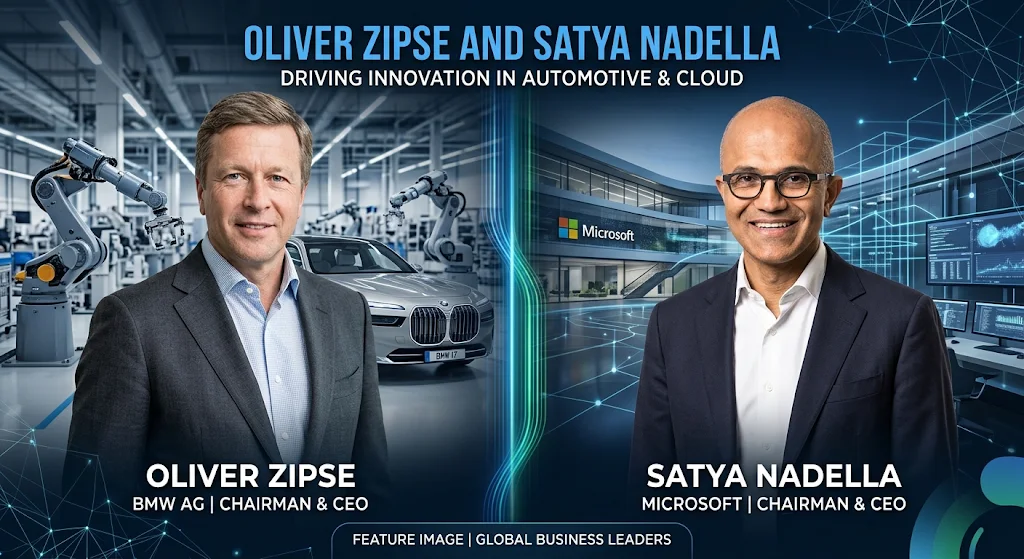
Oliver Zipse and Satya Nadella are two influential business executives whose professional journeys offer an interesting look at how leadership, innovation, and technology are transforming the modern business world. Although they built their careers in different industries, both became associated with major international companies and important changes in their respective fields. Oliver Zipse is best known for his leadership at BMW, one of the world’s most recognized automotive manufacturers, while Satya Nadella is widely known for leading Microsoft through a significant period of technological transformation.
The business environments surrounding these two executives have changed considerably over the years. The automotive industry is moving toward electric mobility, advanced software, artificial intelligence, and connected vehicles. Meanwhile, the technology industry continues to expand through cloud computing, artificial intelligence, cybersecurity, and digital services. These developments demonstrate why executives must continuously adapt their strategies to remain competitive and meet changing customer expectations.
The keyword Oliver Zipse and Satya Nadella brings together two different leadership stories that share several important themes. Their careers provide an opportunity to explore how traditional manufacturing companies and global technology organizations approach innovation, employee development, international competition, and long-term business growth. While there is no established public evidence of a major direct business partnership between the two executives, their professional backgrounds make an interesting comparison.
Who Is Oliver Zipse?
Oliver Zipse is a German business executive and engineer who became widely recognized through his long career at BMW. He joined the company in 1991 and gradually developed experience across several important business areas, including production, strategic planning, engineering, and international operations. His professional background gave him a detailed understanding of how a major automotive manufacturer operates, from developing products to managing complex production facilities.
Before becoming BMW’s chief executive, Zipse held several senior management positions within the organization. He served as managing director of BMW’s Oxford plant in the United Kingdom and later took responsibility for corporate planning and technical production planning. These positions helped him understand the relationship between manufacturing efficiency, product quality, technological development, and international business operations.
In August 2019, Zipse became Chairman of the Board of Management of BMW AG. His leadership period coincided with major changes in the automotive industry, including growing demand for electric vehicles, increasing competition from Chinese manufacturers, and the rapid development of automotive software. His responsibilities included maintaining BMW’s premium brand position while preparing the company for a more technologically advanced future.
Who Is Satya Nadella?
Satya Nadella is an internationally recognized technology executive who became Chairman and Chief Executive Officer of Microsoft. Born in Hyderabad, India, Nadella developed an interest in engineering and technology before moving to the United States to continue his education. He earned an engineering degree in electrical engineering from Manipal Institute of Technology and later completed postgraduate studies in computer science and business administration.
Nadella joined Microsoft in 1992 and spent many years working across different areas of the company. During his career, he gained experience in enterprise software, cloud computing, online services, and business technology. His understanding of Microsoft’s products and organizational structure helped him develop the leadership experience necessary to take responsibility for one of the world’s largest technology companies.
In February 2014, Nadella became Microsoft’s CEO. His leadership marked an important period in the company’s development, particularly because Microsoft increasingly focused on cloud computing, subscription-based services, artificial intelligence, and partnerships with other technology organizations. Instead of depending primarily on its traditional software business, Microsoft expanded its position in several important areas of the global technology market.
Oliver Zipse and Satya Nadella: What Connects These Two Business Leaders?
The professional connection between Oliver Zipse and Satya Nadella is best understood through their influence on technological innovation and international business leadership. Zipse built his reputation in the automotive manufacturing industry, while Nadella developed his career in software, cloud services, and enterprise technology. Their companies operate in different markets, but modern business increasingly requires these industries to work together.
Automotive manufacturers now depend on advanced software systems, cloud infrastructure, artificial intelligence, and digital communication technologies. Vehicles are becoming more connected, and customers increasingly expect intelligent navigation, voice assistants, online services, and software updates. These developments demonstrate how technology companies can influence the future of traditional manufacturing industries.
Similarly, technology companies benefit from working with businesses that understand the needs of real-world industries. Automotive manufacturers, hospitals, financial institutions, and industrial organizations require reliable technology solutions that can improve productivity and customer experiences. The experiences of Zipse and Nadella therefore provide useful examples of how leaders can approach the changing relationship between manufacturing and digital technology.
It is important, however, to distinguish between industry connections and confirmed personal business relationships. BMW has worked with Microsoft on technology initiatives, but this does not automatically establish a separate formal partnership between Zipse and Nadella. Their comparison is primarily based on their respective leadership experiences and the technological changes influencing their companies.
Oliver Zipse’s Leadership and Transformation at BMW
Oliver Zipse’s leadership at BMW involved balancing the company’s traditional strengths with the demands of a rapidly changing automotive market. BMW had already established itself as a premium automotive brand with a strong reputation for engineering, performance, and design. However, the arrival of electric vehicles and advanced digital technologies created new challenges for established manufacturers.
One of the most important priorities during his leadership was the development of BMW’s Neue Klasse platform. This strategic vehicle architecture was designed to introduce significant improvements in electric mobility, battery technology, digital systems, and vehicle efficiency. The objective was not simply to introduce additional electric models but to establish a technological foundation that could influence BMW’s future product range.
Another important aspect of Zipse’s approach was maintaining technological flexibility. Instead of relying entirely on one type of powertrain, BMW continued developing combustion engines, plug-in hybrids, battery-electric vehicles, and plans for hydrogen fuel-cell technology. This strategy reflected the different transportation requirements, regulations, and infrastructure conditions found across international markets.
BMW’s 2026 annual conference highlighted the company’s continued investment in electric mobility and the Neue Klasse program. The company reported 442,056 fully electric vehicle deliveries in 2025, representing 17.9 percent of its total sales. These figures demonstrate the growing importance of electrification in BMW’s long-term business strategy.
Satya Nadella’s Impact on Microsoft’s Growth
Satya Nadella’s leadership at Microsoft is closely associated with the company’s growing emphasis on cloud computing and digital services. Before his appointment as CEO, Microsoft was already a major software company, but its business model faced challenges as customers increasingly adopted cloud-based platforms and mobile technologies.
Under Nadella’s leadership, Microsoft strengthened its cloud computing business through Microsoft Azure. Azure became an important platform for businesses that needed computing infrastructure, data storage, artificial intelligence services, and application development tools. This expansion helped Microsoft compete more effectively in the global cloud computing market.
Another major development was the company’s approach to software subscriptions. Products such as Microsoft 365 helped establish a business model based on recurring services rather than relying exclusively on traditional software purchases. This approach gave customers access to regularly updated applications and collaboration tools while providing Microsoft with a more predictable revenue structure.
Artificial intelligence has also become a central part of Microsoft’s strategy. The company has expanded AI capabilities across its software ecosystem, including productivity applications, cloud services, developer tools, and business solutions. These investments demonstrate Nadella’s interest in making artificial intelligence a practical part of everyday professional activities rather than treating it as an isolated technological experiment.
The BMW and Microsoft Connection: Technology Beyond Traditional Industries
One particularly interesting aspect of the Oliver Zipse and Satya Nadella comparison is the historical relationship between BMW and Microsoft. Both companies have explored how software, cloud infrastructure, and artificial intelligence can improve business operations and customer experiences.
In April 2019, Microsoft and the BMW Group announced the Open Manufacturing Platform. The initiative aimed to encourage collaboration between manufacturing organizations and develop industrial technology solutions that could be used across different production environments. Its broader purpose was to improve manufacturing processes through connected systems, industrial data, and more flexible digital infrastructure.
The initiative reflected the growing importance of smart factories. Modern manufacturing facilities produce large amounts of operational data, and businesses need effective systems to understand and use that information. Cloud technology and industrial connectivity can help companies monitor equipment, improve production planning, and identify potential problems before they interrupt manufacturing operations.
BMW also worked with Microsoft on developments related to intelligent voice interaction. In May 2019, the companies discussed improvements to the BMW Intelligent Personal Assistant using Microsoft’s cloud and artificial intelligence capabilities. The objective was to make vehicle conversations more natural and useful, allowing drivers to interact with digital services through voice commands.
These developments demonstrate why automotive manufacturers increasingly depend on technology companies. They also provide an important industry-level connection between the organizations associated with Zipse and Nadella. However, the corporate initiatives should not be presented as proof of a personal partnership between the two executives.
Different Leadership Styles, Similar Business Challenges
Oliver Zipse and Satya Nadella operate in industries with different priorities, but both have faced the challenge of leading established international organizations through technological change. Their experiences highlight the importance of understanding existing business strengths while preparing for future developments.
Zipse’s professional background in engineering and manufacturing influenced his approach to automotive leadership. His experience across BMW’s production facilities and planning departments gave him a practical understanding of the challenges involved in developing and manufacturing vehicles. Decisions in this industry require considerable attention to product quality, safety, supply chains, production costs, and customer expectations.
Nadella’s background in computer science and enterprise technology shaped his leadership experience at Microsoft. His work involved understanding how software, cloud platforms, and digital services could create new opportunities for businesses and consumers. Microsoft’s international operations also require continuous investment in cybersecurity, research, infrastructure, and relationships with technology partners.
Both careers demonstrate that effective leadership involves more than making short-term business decisions. Executives must understand the direction of their industries, identify opportunities for improvement, and encourage their organizations to develop new capabilities. These responsibilities become particularly important when established companies face competition from younger businesses and rapidly developing technologies.
Their experiences also highlight the value of collaboration. Modern organizations cannot always develop every technological solution independently. Working with specialized companies, research institutions, suppliers, and international partners can help businesses access knowledge and resources that would otherwise be difficult to develop internally.
Artificial Intelligence and the Future of Business
Artificial intelligence is one of the most important developments influencing both the automotive and technology industries. Its applications extend beyond computer programs and online services. AI can support manufacturing operations, improve customer communication, assist engineers, analyze large datasets, and make complex business processes more efficient.
For automotive companies, artificial intelligence can contribute to driver assistance systems, predictive maintenance, intelligent navigation, and personalized vehicle experiences. Manufacturers can also use data analysis to improve production planning and understand how customers use their vehicles. These developments are gradually changing the way automotive products are designed, manufactured, and maintained.
For Microsoft, artificial intelligence represents an opportunity to improve existing software products and expand cloud-based services. AI-powered assistants can help employees summarize documents, organize information, analyze data, and complete routine tasks. Businesses can also use AI services to develop applications that address specific operational requirements.
However, artificial intelligence introduces challenges that companies must address responsibly. Data privacy, cybersecurity, accuracy, transparency, and regulatory compliance are becoming increasingly important. Organizations must ensure that new technologies provide meaningful benefits without creating unnecessary risks for customers and employees.
The experiences of Zipse and Nadella demonstrate two different ways of approaching technological transformation. One involves integrating advanced digital systems into physical products and manufacturing operations, while the other focuses on providing the software and infrastructure that make those systems possible.
Electric Vehicles and the Growing Importance of Software
The automotive industry is experiencing a major transformation as electric vehicles become an increasingly important part of global transportation. Traditional automotive competition focused heavily on engine performance, mechanical engineering, reliability, and design. Today, battery technology, software architecture, charging infrastructure, and digital customer experiences are also important competitive factors.
BMW’s Neue Klasse strategy illustrates this change. The company has been developing a new generation of electric vehicles supported by advanced battery technology and redesigned electronic systems. These developments are intended to improve vehicle efficiency, driving range, charging performance, and digital functionality.
Software is becoming particularly important because modern vehicles increasingly operate as connected digital platforms. Navigation, entertainment, driver assistance, vehicle settings, and communication systems depend on software that must work reliably. Manufacturers also need to support software improvements and updates throughout a vehicle’s useful life.
Microsoft’s technology expertise is relevant to this wider transformation because cloud computing and AI services can support connected business environments. Automotive companies can use digital infrastructure to process information, manage services, and improve communication between different systems.
The relationship between electric vehicles and software shows why the automotive and technology sectors are becoming increasingly interconnected. Future competition will likely depend on how effectively manufacturers combine engineering expertise with digital innovation.
Challenges Facing Oliver Zipse and Satya Nadella’s Industries
Despite their achievements, the industries associated with Oliver Zipse and Satya Nadella face significant challenges. The automotive market is affected by changing customer demand, international trade policies, production costs, environmental regulations, and competition from manufacturers around the world.
BMW must also compete with companies that have developed electric vehicles and digital automotive platforms at a rapid pace. Chinese manufacturers, in particular, have become important competitors in several international markets. Established brands must therefore continue investing in technology while protecting profitability and maintaining their premium positioning.
Microsoft faces a different set of challenges. Competition in cloud computing and artificial intelligence remains intense, with major technology companies investing substantial resources in infrastructure and research. The industry must also address concerns about data security, AI-generated information, energy consumption, and the responsible use of customer data.
Another shared challenge is finding the right balance between innovation and financial performance. Developing new technologies requires considerable investment, but businesses must also demonstrate that these investments can generate sustainable value. Companies cannot depend entirely on exciting announcements; they must deliver reliable products and services that customers are willing to use.
These challenges demonstrate that leadership in a global organization requires continuous evaluation and adjustment. Strategies that work today may need to change as technology, regulations, and customer expectations develop.
Oliver Zipse’s Departure from BMW and the Company’s Next Chapter
An important development in Oliver Zipse’s professional journey was his departure from BMW’s leadership position in May 2026. After approximately 35 years with the company, he concluded a long career that included engineering, production management, strategic planning, and executive leadership.
His departure marked the beginning of a new leadership chapter for BMW. Milan Nedeljković was appointed to succeed him as Chairman of the Board of Management, effective May 14, 2026. The leadership transition came at an important time as BMW continued expanding its electric vehicle portfolio and introducing technologies associated with the Neue Klasse program.
Zipse’s time at BMW was shaped by several major developments, including the expansion of electrification, the modernization of manufacturing processes, and the growing importance of vehicle software. His experience across different departments also provided a broad perspective on the operational challenges facing a major international manufacturer.
Leadership transitions are important because they allow companies to introduce new perspectives while maintaining successful long-term strategies. BMW’s future performance will depend on how effectively its leadership team manages competition, technological investment, production efficiency, and changing customer expectations.
What Businesses Can Learn From Oliver Zipse and Satya Nadella
The careers of Oliver Zipse and Satya Nadella offer several useful lessons for business owners, managers, and aspiring entrepreneurs. One of the most important is the value of continuous learning. Both executives developed their careers through years of experience in their respective industries, building knowledge that helped them make decisions at the highest organizational level.
Another important lesson is the need to adapt to changing markets. Companies cannot expect their previous successes to guarantee future growth. Automotive manufacturers must respond to electric mobility and digital technologies, while software companies must continuously improve their platforms and develop new services.
Their professional experiences also highlight the importance of long-term thinking. Successful business strategies require investments that may take several years to deliver meaningful results. Developing new manufacturing platforms, cloud infrastructure, or artificial intelligence capabilities involves planning, resources, and a willingness to manage uncertainty.
Finally, both careers demonstrate the importance of people and organizational culture. Technology alone does not guarantee success. Companies need skilled employees, effective communication, responsible management, and an environment where people can contribute new ideas. Strong leadership involves helping teams understand business objectives and giving them the resources to achieve those goals.
Frequently Asked Questions About Oliver Zipse and Satya Nadella
1. Who are Oliver Zipse and Satya Nadella?
Oliver Zipse is a German automotive executive best known for his long career at BMW, where he served as Chairman of the Board of Management from 2019 until May 2026. Satya Nadella is an Indian-born American technology executive who serves as Microsoft’s Chairman and CEO. Both are recognized for their contributions to major international businesses.
2. Are Oliver Zipse and Satya Nadella business partners?
There is no established public evidence confirming a major direct business partnership or joint venture between Oliver Zipse and Satya Nadella personally. However, BMW and Microsoft have participated in technology initiatives involving manufacturing platforms, cloud computing, and intelligent vehicle systems.
3. What is Oliver Zipse famous for?
Oliver Zipse is best known for his leadership at BMW and his involvement in the company’s development during a period of significant automotive transformation. His work included production strategy, electrification, manufacturing modernization, and the development of the Neue Klasse vehicle platform.
4. What is Satya Nadella famous for?
Satya Nadella is best known for leading Microsoft’s transformation toward cloud computing, enterprise services, and artificial intelligence. His leadership helped strengthen Microsoft’s position in the global technology market and expand its range of digital products and services.
5. Did BMW and Microsoft work together?
Yes. BMW and Microsoft announced the Open Manufacturing Platform in 2019 to support industrial collaboration and the development of smart manufacturing solutions. They also explored AI-powered improvements to BMW’s Intelligent Personal Assistant.
6. Is Oliver Zipse still the CEO of BMW?
No. Oliver Zipse left his position as Chairman of BMW’s Board of Management in May 2026. Milan Nedeljković succeeded him, taking office on May 14, 2026.
7. Is Satya Nadella still leading Microsoft?
Yes. Satya Nadella continues to serve as Microsoft’s Chairman and Chief Executive Officer. His leadership remains closely associated with the company’s cloud computing and artificial intelligence strategies.
8. What industries are connected to Oliver Zipse and Satya Nadella?
Oliver Zipse is associated primarily with automotive manufacturing, engineering, and electric mobility. Satya Nadella is associated with software, cloud computing, artificial intelligence, and enterprise technology. Their industries increasingly overlap through connected vehicles, digital manufacturing, and intelligent software systems.
Conclusion
Oliver Zipse and Satya Nadella represent two different approaches to leadership in an increasingly technology-driven global economy. Zipse built his reputation through decades of experience in automotive engineering, manufacturing, and executive management at BMW. Nadella developed his career through software, cloud computing, and enterprise technology before becoming one of the most influential leaders in the technology industry.
Although there is no confirmed major direct business partnership between the two executives, their professional journeys reveal several important similarities. Both have been associated with organizations that needed to adapt to changing markets, invest in new technologies, and develop strategies for long-term growth. Their industries also demonstrate how digital innovation is influencing almost every part of the modern economy.
The historical collaboration between BMW and Microsoft provides an additional perspective on this changing business environment. From smart manufacturing initiatives to intelligent vehicle assistants, the automotive and technology sectors have opportunities to create value through cooperation and innovation.
Ultimately, the story of Oliver Zipse and Satya Nadella is about more than two successful executives. It highlights the importance of strategic thinking, continuous improvement, technological investment, and responsible leadership. Their different professional experiences offer useful lessons for anyone interested in understanding how global businesses prepare for the future.
You May Also Read Mario Gabelli and Angelina Jolie