
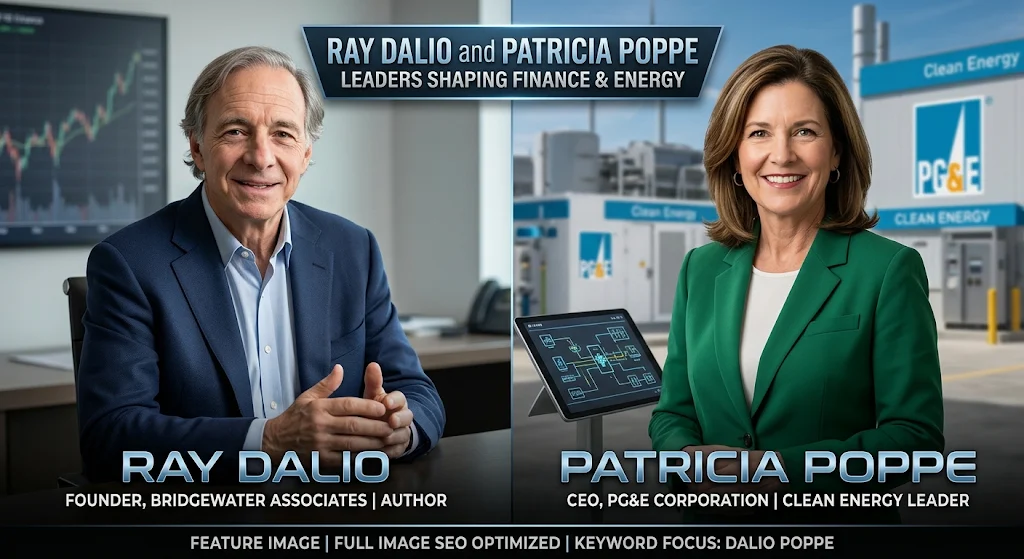
Ray Dalio and Patricia Poppe are two well-known American business figures whose professional journeys have developed in different industries. Ray Dalio is recognized for founding Bridgewater Associates, one of the world’s most influential investment management firms, while Patricia Poppe, widely known as Patti Poppe, has built her reputation through leadership roles in the energy and utility sectors. Although their careers may initially appear unrelated, their professional backgrounds offer an interesting opportunity to explore investment management, corporate leadership, business strategy, and the importance of long-term decision-making.
When people search for Ray Dalio and Patricia Poppe together, one important question is whether the two have a direct personal or professional relationship. Their names have appeared together in discussions involving Bridgewater Associates and PG&E Corporation. However, it is important to distinguish between an institutional financial connection and a personal relationship. Publicly available information does not establish that Dalio and Poppe are relatives, business partners, or direct professional collaborators.
Despite their different career paths, both individuals have made significant contributions to their respective industries. Dalio developed an investment philosophy based on research, economic cycles, and carefully established principles. Poppe, meanwhile, has focused on improving utility operations, strengthening workplace safety, and delivering reliable energy services. Their experiences demonstrate how leadership can take different forms depending on the challenges an organization faces.
Who Is Ray Dalio? Understanding His Background and Career
Ray Dalio is an American billionaire investor, entrepreneur, author, and philanthropist best known for establishing Bridgewater Associates in 1975. He developed an interest in financial markets at a relatively young age and purchased his first stock when he was just 12 years old. That early experience helped introduce him to the possibilities and uncertainties of investing, eventually inspiring a career that would influence the global financial industry.
Dalio studied finance at C.W. Post College, graduating in 1971, before earning an MBA from Harvard Business School in 1973. His education provided a foundation for understanding financial markets, economic behavior, and investment strategies. After gaining experience in the financial industry, he decided to establish his own investment management business. What began as a relatively small operation eventually developed into a major global investment organization.
Bridgewater Associates became particularly recognized for its global macro investment strategies. Rather than concentrating exclusively on individual companies, this approach examines broader economic forces, including inflation, interest rates, government policies, currency movements, and economic growth. Dalio believed that understanding how these factors interact could help investors make more informed decisions across different market environments.
How Ray Dalio Built Bridgewater Associates
Dalio founded Bridgewater Associates in 1975, initially operating the business from his apartment in New York. The company started by providing economic research, financial advice, and investment-related services to institutional clients. Over time, its research capabilities and investment strategies attracted larger organizations, helping Bridgewater establish a stronger position within the financial industry.
One of the important turning points in Bridgewater’s development came when institutional investors began trusting the firm’s economic research and investment management approach. Its clients included major organizations seeking professional guidance on financial markets and economic risks. As the business expanded, Bridgewater became known for its distinctive investment strategies and research-driven organizational culture.
Dalio also introduced a management philosophy centered on transparency, independent thinking, and learning from mistakes. He encouraged employees to challenge assumptions, discuss disagreements openly, and evaluate decisions using evidence rather than personal preferences. These ideas became closely associated with his book Principles: Life and Work, which introduced his approach to decision-making and organizational management to a much wider audience.
Ray Dalio’s Investment Philosophy and Business Principles
One of the most recognizable aspects of Ray Dalio’s career is his belief that successful investing requires understanding how economic systems operate. He has spent decades studying historical financial events, market cycles, debt patterns, and monetary policy. His approach encourages investors to look beyond short-term market movements and consider the underlying forces that influence economic conditions.
Dalio also developed the concept of radical transparency within the workplace. This philosophy encourages individuals to communicate honestly, share different perspectives, and identify mistakes without unnecessarily hiding uncomfortable information. In his view, organizations become stronger when employees are willing to question ideas and focus on finding the best possible answers rather than simply agreeing with senior management.
Another important part of his philosophy involves diversification and risk management. Dalio has frequently discussed the importance of building investment portfolios that can perform under different economic conditions. His All Weather investment approach became associated with the idea that investors should consider how assets behave during periods of economic expansion, recession, inflation, and deflation. These principles have made his work influential among investors and business professionals.
Who Is Patricia Poppe? Her Background and Professional Journey
Patricia Poppe, commonly called Patti Poppe, is an American business executive recognized for her leadership in the energy and utility industries. She became particularly prominent after joining PG&E Corporation as its chief executive officer in January 2021. Her professional background is different from Dalio’s because her experience developed through engineering, manufacturing, power generation, and utility operations rather than investment management.
Poppe received her bachelor’s and master’s degrees in industrial engineering from Purdue University. She also earned a master’s degree in management from Stanford Graduate School of Business. Her educational background combined technical knowledge with business management skills, giving her experience in understanding both operational challenges and broader organizational decisions.
Before joining PG&E, Poppe held several important positions in the energy industry. She worked at DTE Energy and later spent years at CMS Energy and its principal subsidiary, Consumers Energy. During her career, she gained experience in power generation, distribution operations, engineering, customer experience, and regulatory matters. These responsibilities helped prepare her for senior executive positions in the utility sector.
Patricia Poppe’s Leadership at PG&E Corporation
Patricia Poppe joined PG&E Corporation in January 2021, taking responsibility for leading a company facing considerable operational and reputational challenges. PG&E serves millions of customers across Northern and Central California, making its responsibilities particularly important for households, businesses, and communities throughout the region.
The company operates in an environment where safety, reliability, affordability, and environmental responsibility are major priorities. California’s wildfire risks have also created significant challenges for electricity providers. Managing infrastructure, maintaining equipment, responding to emergencies, and improving public confidence are all essential parts of operating a utility business.
Under Poppe’s leadership, PG&E emphasized operational improvements and the implementation of lean business principles. These methods focus on reducing unnecessary processes, improving efficiency, and making better use of organizational resources. Her leadership has also emphasized workplace safety and customer experience, reflecting the importance of connecting operational performance with the needs of the people who depend on electricity services.
What Connects Ray Dalio and Patricia Poppe?
The connection between Ray Dalio and Patricia Poppe is primarily institutional rather than personal. Dalio founded Bridgewater Associates, while Poppe leads PG&E Corporation. Their associated organizations entered the same financial discussion through Bridgewater’s reported investment position in PG&E Corporation.
Investment disclosures provide information about securities held by institutional investment managers. In 2026, Bridgewater Associates reported a substantial position in PG&E Corporation shares in its second-quarter investment disclosure. The reported holding was approximately 5.93 million shares, with a quarter-end market value of roughly $99.8 million.
However, these figures require careful interpretation. The investment disclosure identifies Bridgewater Associates as the reporting institutional investment manager. It does not establish that Ray Dalio personally purchased the shares, selected the investment, or directed the transaction. Dalio had already completed his exit from Bridgewater’s ownership in 2025, following a multiyear transition.
Therefore, the most accurate explanation is that Bridgewater Associates reported an investment position in the company led by Patricia Poppe. This represents a financial connection between two organizations, not proof that Dalio and Poppe personally worked together or maintained a business partnership.
Are Ray Dalio and Patricia Poppe Related?
There is no reliable publicly available evidence establishing that Ray Dalio and Patricia Poppe are family members. Their professional biographies describe separate backgrounds, educational experiences, and career developments. Neither individual’s established professional profile identifies the other as a relative or personal business associate.
It is also important to understand that two business figures appearing together in investment-related discussions does not automatically indicate a personal relationship. Large investment management firms hold securities across numerous industries, including energy, technology, manufacturing, healthcare, and financial services. Such investments can create indirect connections between organizations without creating direct relationships between their founders and executives.
For readers researching this topic, separating confirmed information from assumptions is essential. There is no publicly established evidence that Dalio and Poppe are married, related, co-founders, or direct professional collaborators. Their most notable documented connection involves Bridgewater Associates and PG&E Corporation.
Comparing Ray Dalio and Patricia Poppe’s Leadership Styles
Ray Dalio and Patricia Poppe offer two different examples of leadership because they have worked in industries with very different responsibilities. Dalio’s career has focused on investment decisions, financial research, economic forecasting, and managing institutional capital. His leadership philosophy emphasizes analytical thinking, systematic decision-making, and the importance of learning from both successful and unsuccessful decisions.
Poppe’s leadership approach has developed within an industry where operational reliability and public safety are central responsibilities. Energy companies must maintain physical infrastructure, respond to emergencies, manage employees, and comply with complex regulatory requirements. Her professional experience has encouraged an emphasis on operational discipline, efficiency, employee engagement, and customer service.
Despite these differences, both leaders demonstrate the importance of building an organizational culture that supports long-term performance. Dalio has emphasized transparency and clear principles, while Poppe has highlighted safety, teamwork, and improving the customer experience. Their approaches show that effective leadership does not follow a single formula. It depends on understanding an organization’s responsibilities and creating systems that help employees deliver results.
What Business Professionals Can Learn From Their Careers
One important lesson from Dalio’s career is the value of continuous learning. Financial markets constantly change, and investment strategies that work under one economic environment may not perform as expected under another. His experience demonstrates why business professionals should regularly examine their assumptions, study historical information, and remain open to changing their decisions when new evidence becomes available.
Poppe’s career offers another important lesson: strong leadership requires understanding the operational details of a business. Executives cannot depend entirely on financial reports or corporate presentations when the success of an organization depends on employees, equipment, infrastructure, and customers. Her experience across manufacturing and energy operations demonstrates the value of understanding how an organization functions at different levels.
Both careers also highlight the importance of accountability. Investment managers must understand the risks associated with financial decisions, while utility executives must consider the consequences of operational decisions for employees and communities. Different industries create different forms of responsibility, but both require leaders to think beyond immediate results.
The Importance of Investment Management and the Energy Industry
Investment management and energy infrastructure are two important parts of the modern economy. Investment firms help individuals and institutions allocate capital, manage financial risks, and pursue long-term financial objectives. Companies such as Bridgewater Associates operate in a complex environment influenced by interest rates, economic growth, market expectations, and international developments.
Energy companies have a different but equally important responsibility. They provide essential services that support homes, businesses, transportation, and industrial activity. PG&E Corporation operates within a highly regulated environment where infrastructure investment, wildfire prevention, electricity reliability, and customer affordability remain significant considerations.
The relationship between financial institutions and energy companies is an important part of the broader economy. Investment managers may purchase shares in utility companies because they see potential financial opportunities or wish to diversify their portfolios. However, an investment does not necessarily mean that the investor controls the company or participates in its daily management.
This distinction helps explain why Bridgewater’s reported PG&E investment can be relevant to discussions about Dalio and Poppe without suggesting that the two individuals share executive responsibilities.
Ray Dalio’s Life After Bridgewater Ownership
Ray Dalio’s relationship with Bridgewater changed significantly over several years as the company moved toward a new generation of leadership. He stepped down as chief executive officer in 2017, followed by his departure from the chief investment officer role in 2020 and chairman position at the end of 2021.
The transition continued in 2022, when control of the organization passed to a new generation of leaders and investors. In July 2025, Bridgewater completed the repurchase of the remaining ownership shares held by Dalio-related entities, according to reporting by Reuters. This marked an important milestone in his separation from the firm’s ownership structure.
Although his formal involvement changed, Dalio continued to be associated with investing, economic research, writing, and sharing his business principles. His books and public discussions have introduced his thinking to audiences interested in finance, management, and personal development.
His experience demonstrates that building a successful organization involves more than establishing a profitable business. It also involves developing leadership systems, preparing future executives, and creating an organizational structure capable of operating beyond the founder’s direct involvement.
Patricia Poppe’s Vision for the Future of Energy
The energy industry is experiencing significant changes as electricity demand, technology, environmental expectations, and infrastructure requirements continue to evolve. Utility companies must prepare for new challenges while maintaining reliable service for existing customers. These responsibilities make long-term planning especially important for companies operating in California.
At PG&E Corporation, major priorities include improving wildfire safety, maintaining infrastructure, increasing operational efficiency, and supporting the transition toward cleaner energy. These goals require coordination among engineers, field employees, executives, regulators, and local communities.
Poppe’s leadership has emphasized the importance of safety and operational improvements as the company works through these challenges. Reliable electricity is essential for everyday life, and utility companies must balance investment requirements with the affordability concerns of their customers.
Her professional journey also demonstrates how technical knowledge and management experience can complement each other. Understanding engineering operations while managing a large corporation requires both practical knowledge and the ability to make strategic decisions. These qualities remain important for leaders navigating the changing energy industry.
Frequently Asked Questions About Ray Dalio and Patricia Poppe
1. Who are Ray Dalio and Patricia Poppe?
Ray Dalio is an American investor and entrepreneur best known for founding Bridgewater Associates in 1975. Patricia Poppe, also known as Patti Poppe, is an American energy executive who became the chief executive officer of PG&E Corporation in January 2021. Both are recognized for their leadership in different areas of the business world.
2. Are Ray Dalio and Patricia Poppe business partners?
There is no publicly verified evidence establishing a direct business partnership between Ray Dalio and Patricia Poppe. The documented connection involves Bridgewater Associates, the investment firm Dalio founded, and PG&E Corporation, the company Poppe leads.
3. Are Ray Dalio and Patricia Poppe related?
No reliable public information establishes that they are relatives or share a family relationship. Their professional histories and educational backgrounds are separate, and their names are associated primarily through an institutional investment connection.
4. Did Ray Dalio personally invest in PG&E Corporation?
Bridgewater Associates reported a position in PG&E Corporation shares in its 2026 investment disclosure. However, this filing does not establish that Dalio personally purchased the shares or made the investment decision. It is important to distinguish the investment manager’s reported holdings from an individual’s personal portfolio.
5. What is Ray Dalio best known for?
Ray Dalio is best known for founding Bridgewater Associates and developing investment and management principles based on research, transparency, economic cycles, and systematic decision-making. He is also widely recognized for his book Principles: Life and Work.
6. What is Patricia Poppe known for?
Patricia Poppe is known for her leadership in the American energy industry. She previously held senior positions at CMS Energy and Consumers Energy before joining PG&E Corporation as CEO in January 2021. Her work has focused on operational efficiency, safety, infrastructure, and customer experience.
7. Does Ray Dalio still own Bridgewater Associates?
No. Ray Dalio completed his exit from Bridgewater’s ownership in July 2025, when the firm repurchased the remaining shares held by Dalio-related entities. He had transferred executive leadership and control to other leaders in earlier stages of the transition.
8. What makes their leadership journeys interesting?
Their careers demonstrate two different approaches to managing complex organizations. Dalio developed a research-focused investment business, while Poppe built her experience through engineering, manufacturing, and energy operations. Both illustrate the importance of long-term planning, organizational culture, and accountability.
Conclusion
Ray Dalio and Patricia Poppe have established successful careers in two very different areas of the American business landscape. Dalio became internationally recognized through his work in investment management and the development of Bridgewater Associates. Poppe built her reputation through engineering, manufacturing, energy operations, and executive leadership at major utility companies.
Their names appear together because of a documented institutional connection involving Bridgewater Associates and PG&E Corporation. Bridgewater reported a significant PG&E shareholding in 2026 while Poppe was serving as the utility company’s parent corporation’s CEO. Nevertheless, this financial connection should not be confused with a confirmed personal relationship or direct business partnership.
Ultimately, their professional journeys offer valuable lessons about leadership, decision-making, innovation, and organizational responsibility. Dalio’s experience highlights the importance of research and systematic thinking, while Poppe’s career demonstrates the value of operational knowledge, safety, and customer-focused management. Understanding both careers provides a clearer picture of how successful leaders contribute to different industries while navigating the challenges of an increasingly complex business environment.
You May Also Read Oliver Zipse and Satya Nadella